
Demand Upgrade Drives Industry Evolution: Paper Edge Protectors Lead the Green Packaging Market with Core Advantages
Against the backdrop of the packaging industry's transformation toward green, intelligent, and efficient practices, paper edge protectors — as a packaging accessory combining protective functionality with environmental value — are facing unprecedented growth opportunities. In recent years, with the improvement of global logistics systems, the upgrading of manufacturing industries, and the widespread adoption of environmental protection concepts, the market demand for paper edge protectors has continued to rise. Not only have their application scenarios expanded, but product quality has also been continuously improved. Their importance in the packaging field is becoming increasingly prominent, making them a significant force driving the development of the green packaging industry. According to relevant market research data, the global paper edge protector revenue scale reached the tens of billions of RMB level in 2025, and is expected to achieve substantial growth by 2032, indicating enormous market development potential.
The utility of paper edge protectors spans the entire chain of product production, packaging, transportation, and warehousing. Their core value lies in providing comprehensive protection and packaging optimization for products, addressing pain points faced by various industries in product packaging processes. In the production and processing stage, paper edge protectors can be used for edge protection of various products, preventing bumps and wear during production handling and semi-finished product storage, thereby ensuring product quality at the point of shipment. In the product packaging stage, paper edge protectors can be used in combination with packaging materials such as cartons, bubble film, and stretch film. They not only reinforce the packaging structure but also standardize packaging appearance, making product packaging more neat and enhancing the product's visual appeal. During long-distance transportation and cross-border sea freight, paper edge protectors effectively resist external environmental influences such as bumps, compression, and humidity. In particular, moisture-proof treated paper edge protectors can control moisture content below 3%, adapting to climatic conditions in different regions and protecting products from damage.
For different industries, the utility of paper edge protectors presents differentiated characteristics, but the core demand consistently revolves around protection and efficiency. In the building materials industry, products such as stone, panels, and pipes have fragile edges and are relatively heavy. Paper edge protectors effectively disperse product weight, prevent edge damage, and facilitate product stacking and handling. In the home appliance industry, large appliances such as refrigerators, washing machines, and televisions are prone to edge dents and outer shell wear due to impact during transportation. Paper edge protectors can precisely fit the edges and corners of appliances, forming a robust protective layer and reducing cargo damage rates. In the food and pharmaceutical industries, the safe, non-toxic, and biodegradable characteristics of paper edge protectors meet the stringent requirements of these industries for packaging materials, while also reinforcing packaging and preventing breakage, ensuring safe product transportation. Additionally, in cross-border trade, paper edge protectors comply with various countries' environmental import standards, eliminating concerns about environmental trade barriers and making them an ideal choice for international packaging.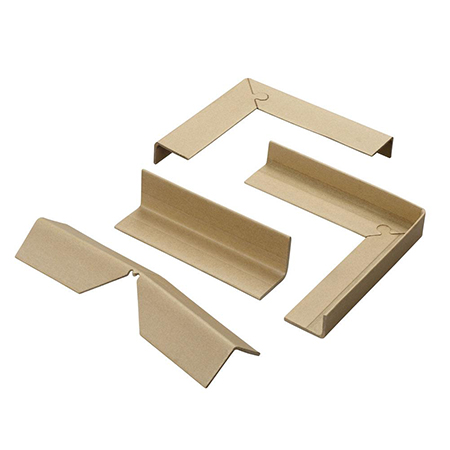
Paper edge protectors stand out in fierce market competition due to their irreplaceable core advantages. Compared to traditional protective materials, the environmental advantages of paper edge protectors are particularly prominent, aligning with the global concept of sustainable development. Currently, many countries are introducing environmental protection policies that restrict the use of non-biodegradable packaging materials. Paper edge protectors, made from recycled paper pulp or kraft paper as raw materials, are recyclable and have a degradation period of only 2-3 months. Compared to products such as plastic edge protectors, their environmental friendliness is significantly higher, making them an important choice for enterprises practicing green development concepts. At the same time, paper edge protectors offer significant cost advantages. Raw material costs account for 60%-70% of total costs, and raw materials are widely available with simple production processes. Compared to metal or wooden edge protectors, they not only have lower procurement costs but also effectively reduce logistics and transportation costs, helping enterprises control packaging expenses and enhance market competitiveness.
Beyond environmental and cost advantages, paper edge protectors also feature high customizability, convenient operation, and strong safety. As market demands continue to upgrade, requirements for the dimensions, thickness, shape, and other aspects of paper edge protectors across various industries have become increasingly diverse. Paper edge protectors can be flexibly customized according to customer needs, from 30mm to 100mm in edge width and 3mm to 8mm in thickness, all precisely adaptable. Additionally, personalized treatments such as lamination and printing can be applied to meet enterprises' branding and packaging needs. In terms of operation, paper edge protectors are lightweight, easy to cut, and easy to install. They require no specialized technicians or tools and can be quickly integrated into enterprise packaging processes, improving packaging efficiency and reducing labor costs. Furthermore, paper edge protectors have no sharp edges and will not scratch operators or products, making them significantly safer than products such as metal edge protectors.
Currently, the market demand for paper edge protectors is showing trends of diversification and high quality. The growth in market demand primarily stems from three sources. First, the rapid development of the logistics industry — especially the explosive growth of the e-commerce sector — has led to a continuous increase in cargo transportation volume and rising demand for packaging protection, directly driving the demand growth for paper edge protectors. The logistics industry now accounts for 42% of paper edge protector demand. Second, driven by environmental policies, governments are imposing increasingly stringent requirements for green packaging. To comply with environmental standards, enterprises are replacing traditional protective materials and turning to eco-friendly products such as paper edge protectors, further expanding market demand. Third, as manufacturing industries upgrade, requirements for the safety, aesthetics, and efficiency of product packaging continue to rise. The multifunctionality and high adaptability of paper edge protectors can meet the diverse needs of enterprises, driving continued growth in market demand.
Looking ahead, with continuous technological innovation and ongoing expansion of application scenarios, the paper edge protector industry will usher in a new round of development opportunities. On the one hand, enterprises will continuously optimize production processes, improve core performance indicators such as compressive strength and moisture resistance, and introduce more high-quality, multifunctional paper edge protector products. On the other hand, the application fields of paper edge protectors will further expand, gradually penetrating emerging industries such as new energy and high-end manufacturing, with market demand continuing to be released. Industry experts predict that in the coming years, the paper edge protector industry will gradually achieve large-scale and standardized development, with continuous optimization of product structures and sustained enhancement of core competitiveness. It is poised to become one of the most promising sub-segments in the green packaging industry, providing strong support for the global packaging industry's green transformation.